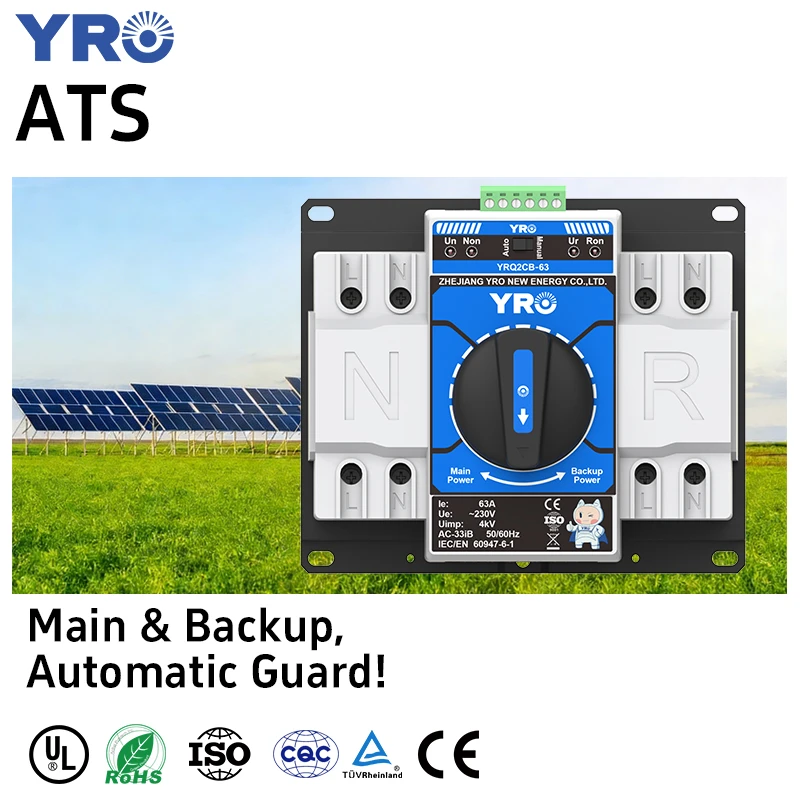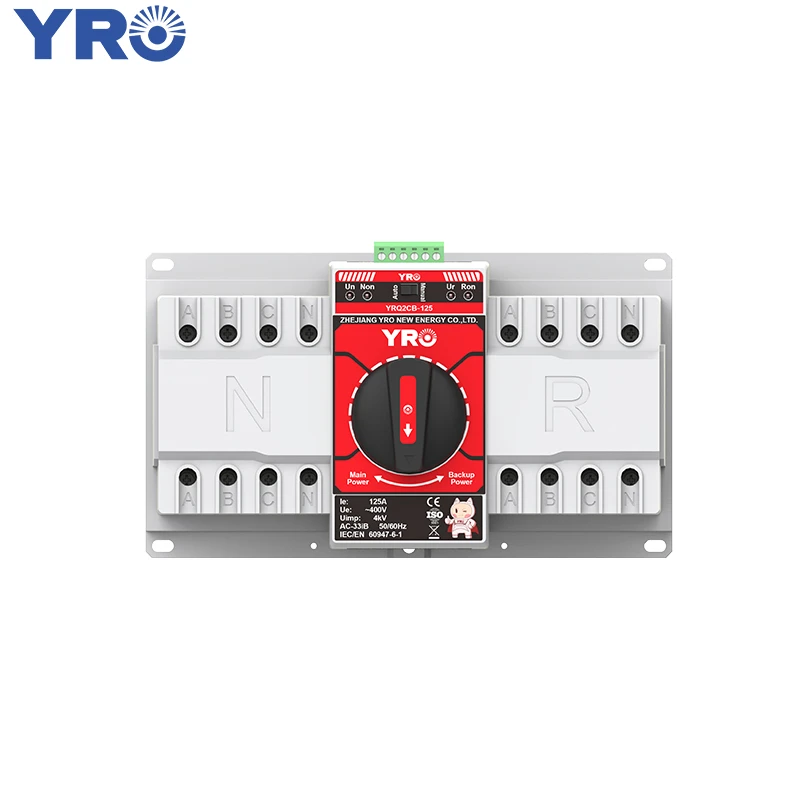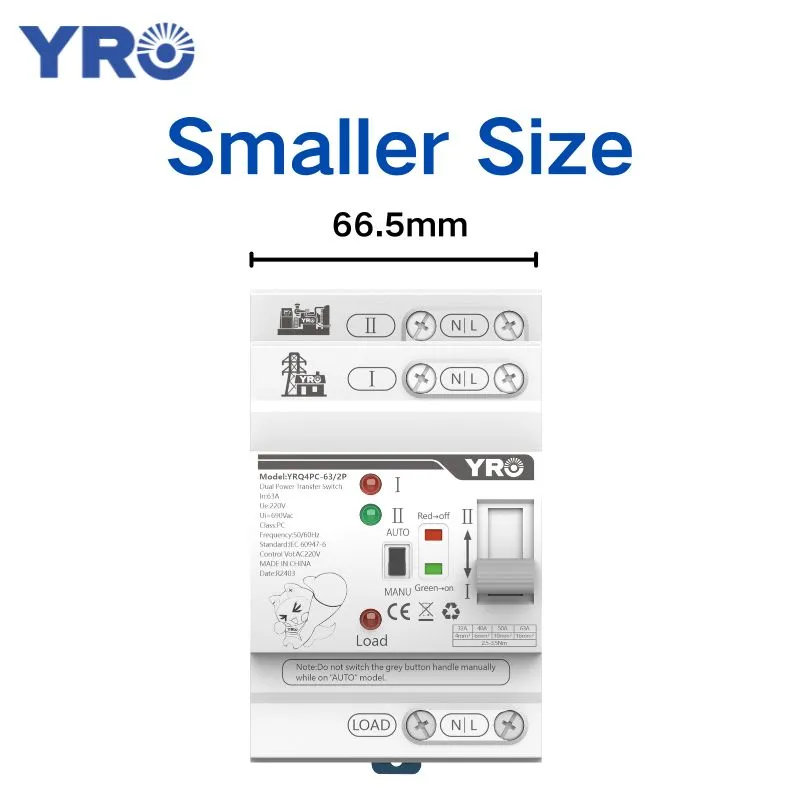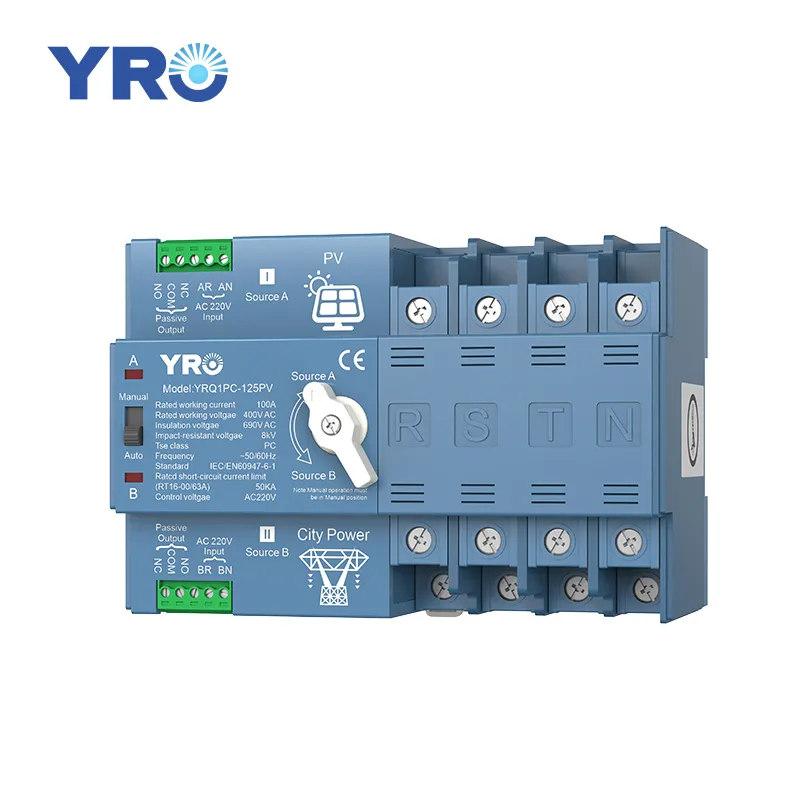
In Germany, as the application of solar energy grows rapidly, more and more installers and end-users are no longer concerned about the fundamental issues but are facing more practical challenges in system integration. One of the frequently mentioned problems is:
Can the dual-power automatic transfer switch (ATS) connect the photovoltaic inverter and the grid simultaneously and maintain stable system operation?
Why Is This Configuration Becoming More Common in Germany?
Germany’s energy structure is rapidly transitioning toward distributed generation. Both residential and commercial users are increasingly combining PV systems with the grid to achieve stable power supply.
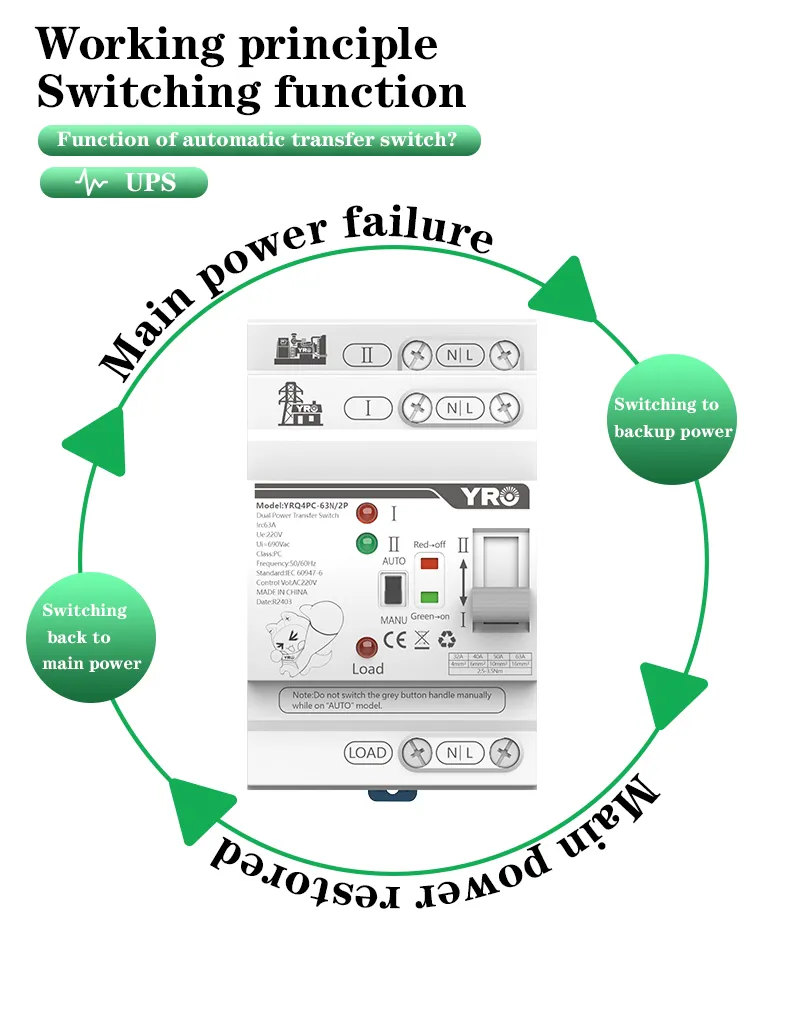
In this application, the ATS is typically used to manage two power sources:
- Primary power: PV inverter output
- Backup power: Utility grid
This configuration allows priority use of solar energy while automatically switching to the grid when PV generation is insufficient, ensuring continuity of power supply. However, the way an ATS operates determines that it cannot connect both power sources at the same time.
Practical Issues When Connecting a Backup Power Transfer Switch to Both PV and Grid Simultaneously
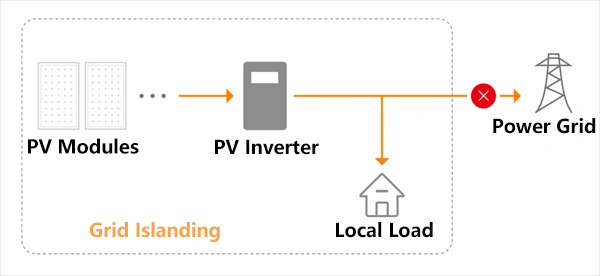
Anti-Islanding Protection
The grid-connected PV inverter must comply with safety standards, and one of its important functions is anti-islanding protection. In simple terms, when the grid is powered off, the inverter must stop outputting power within a specified time (usually several milliseconds to two seconds). This is done to prevent the inverter from continuing to supply power to the grid and to avoid the risk of electric shock to workers who are repairing the grid.
If the automatic transfer switch connects the inverter and the grid to the load simultaneously, and the grid is actually in a power-off state, then the inverter will send power back to the grid side. This situation will cause the anti-islanding protection to fail, leading to safety hazards. Even if the ATS attempts to simultaneously connect the two power sources during normal switching, the inverter will report an error or shut down due to detecting abnormal voltage.
Phase Synchronization
The grid delivers alternating current, which has three key parameters: voltage, frequency, and phase. The grid’s phase is fixed, while a PV inverter operating independently determines its own phase. If two AC power sources with different phases are connected directly together, current forms a loop between them, generating a large inrush current. This surge can damage the internal power components of the inverter and may cause circuit breakers to trip. In severe cases, it can create arcing.
Even when the inverter operates in grid-tied mode, it actively tracks the grid’s phase. If the ATS connects both the inverter and the grid to the load at the same time, the inverter detects two different voltage signals simultaneously, which can disrupt its control logic.
Design Purpose of the Backup Power Transfer Switch
It should be known that ATS is for selecting power sources, not merging power sources. Its function is to switch between power sources, rather than allowing two power sources to work simultaneously. If ATS is forced to simultaneously connect two inputs, additional synchronization detection and control circuits are required, which are not present in standard products.
Based on the above three points, standard ATS is not suitable for connecting solar inverters and the grid simultaneously.
Clearing Up Common Misconceptions About Transfer Switches and PV Integration
Misconception 1: The Faster the ATS Switches, the Better, Without Considering Load Characteristics
Fast switching does reduce the duration of load power loss, but not all loads are suitable for extremely fast switching. Certain motor-type loads require a brief delay before restarting after power loss; otherwise, the phase difference between residual voltage and the restored power supply may cause a surge. Additionally, inverters need some response time when switching from grid-tied mode to off-grid mode. If the ATS switches too quickly, it may connect the load before the inverter has stabilized its output, which can actually cause the inverter to shut down protectively. Therefore, the switching speed of the ATS needs to match the characteristics of both the inverter and the load, rather than simply pursuing speed.
Misconception 2: PV Voltage Is Unstable, and the Electric Power Transfer Switch Will Automatically Regulate the Voltage
The conversion switch does not have voltage regulation capability. It only detects whether the voltage is within the set range and decides whether to switch the power source accordingly. If the photovoltaic output is unstable, the ATS will not “correct” the voltage. The actual voltage stabilization is the responsibility of other voltage protection devices, not the ATS.
Misconception 3: As Long as an ATS Is Installed, the PV System Will Not Experience Power Loss
An ATS can switch between power sources, but it does not guarantee seamless power transfer. Particularly in PV systems, when inverter output is unstable or switching delays are set too long, brief power interruptions can still occur. Therefore, the ATS improves power supply reliability but does not completely eliminate power loss.
Misconception 4: Any ATS Can Be Directly Used in a PV System
Not all ATSs are suitable for photovoltaic applications. Some ordinary ATSs were designed only for grid and generator switching and have weak or no ability to recognize the inverter output signal. Therefore, in the photovoltaic system, a matching ATS solution for the photovoltaic needs to be used.
Misconception 5: An ATS Can Solve All Compatibility Issues in a PV System
The ATS is just one switching component within the system. It cannot resolve compatibility issues related to the inverter, grid, voltage, frequency, and other factors. If the system itself is not properly designed—for example, if voltage ranges do not match or wiring is not up to standard—even using an ATS will not guarantee stable operation. True stability comes from overall system design, not from a single device.
Conclusion
Then, can the ATS connect both the photovoltaic inverter and the power grid simultaneously? The answer is no.
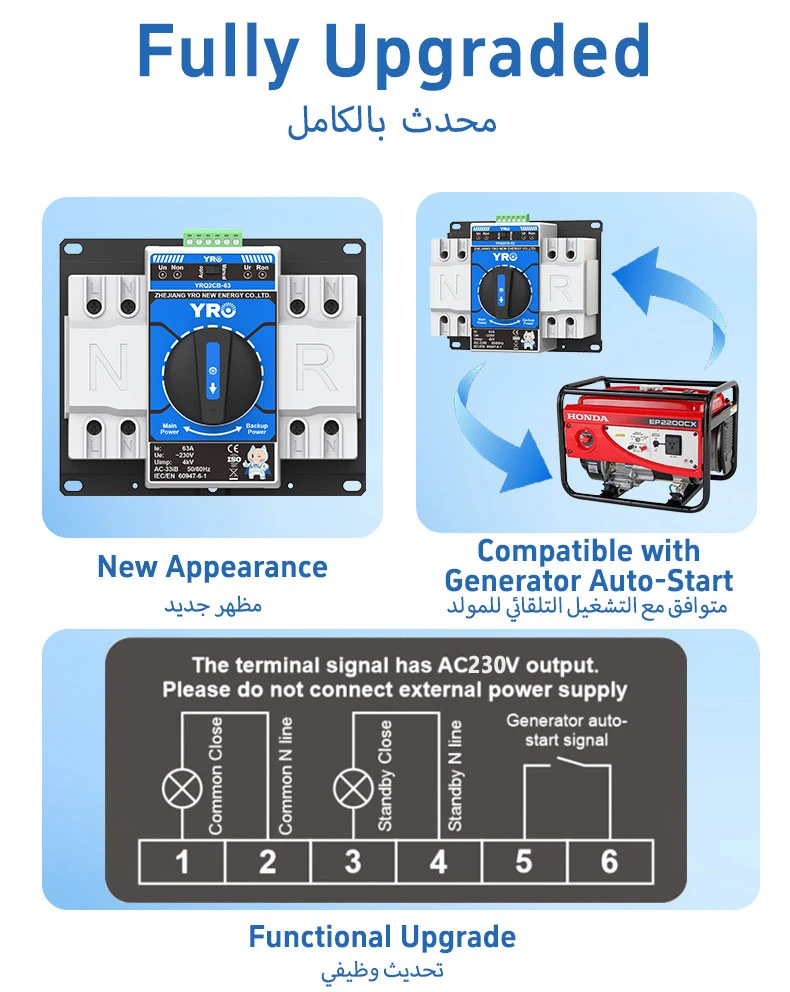
The ATS produced by YRO focuses on power switching. It has undergone multiple laboratory tests and can stably complete the switching action under the rated current, without the risk of contact welding or poor contact. For systems that require stable backup power switching, the ATS sold by YRO provides a reliable foundation guarantee.